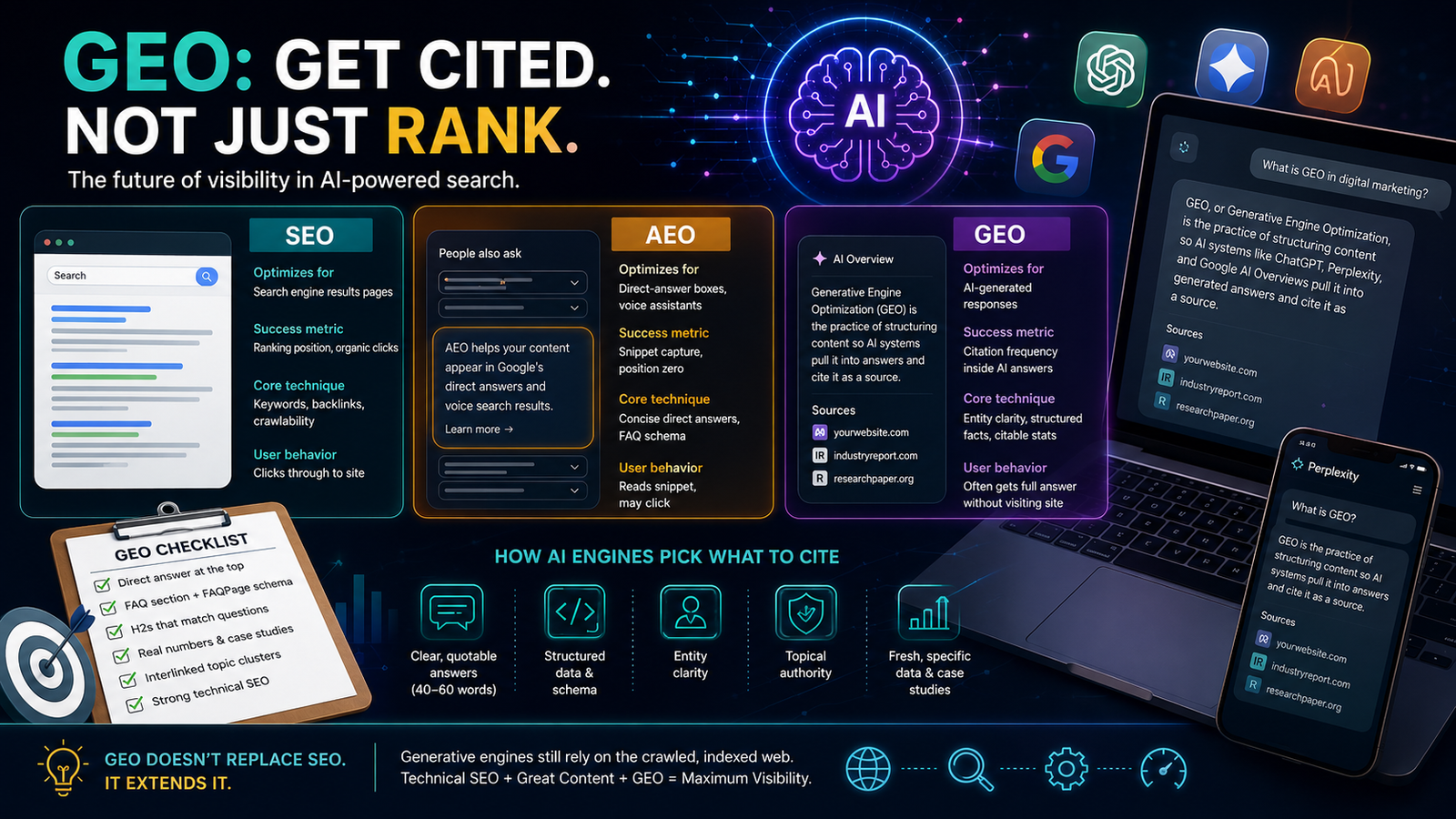
GEO is the practice of structuring content so AI systems pull it into generated answers and cite it as a source. This is framed by What Is GEO (Generative Engine Optimization) and How Is It Different from SEO.
Unlike SEO, which optimizes for ranking in a list of blue links, GEO has a different goal. GEO aims to be the sentence an AI quotes.
It relies on clear entity definitions, structured data (schema), and direct-answer formatting. It emphasizes topical authority over backlinks and keyword density alone.
SEO vs. AEO vs. GEO
| SEO | AEO | GEO | |
| Optimizes for | Search engine results pages | Direct-answer boxes, voice assistants | AI-generated responses |
| Success metric | Ranking position, organic clicks | Snippet capture, position zero | Citation frequency inside AI answers |
| Core technique | Keywords, backlinks, crawlability | Concise direct answers, FAQ schema | Entity clarity, structured facts, citable stats |
| User behavior | Clicks through to site | Reads snippet, may click | Often gets full answer without visiting site |
These overlap heavily – good AEO usually strengthens GEO, and both sit on top of solid technical SEO.
Why GEO Matters Now (2026)
AI-powered search and chat tools have become the primary starting point for many research-heavy queries. When a generative engine provides an answer directly, it draws from a limited set of trusted, citable sources. This discussion connects to What Is GEO (Generative Engine Optimization) and How Is It Different from SEO, highlighting how content structure can influence results.
If your content isn’t structured to be citable, you’re invisible in that answer regardless of traditional ranking, which means that how you format, attribute sources, and present citations matters for visibility and trust in automated answers.
How Generative Engines Pick What to Cite
- Clear, quotable direct answers (40-60 words) near the top of the page.
- Structured data – FAQPage, HowTo, Article schema.
- Entity clarity – precise, consistent terminology.
- Topical authority – multiple in-depth pieces on one subject.
- Fresh, specific data points – real numbers and named case studies over vague claims.
A Practical GEO Checklist
- Open every article with a direct, self-contained answer.
- Add FAQ sections with FAQ Page schema.
- Use H2s that mirror how people phrase questions.
- Include real numbers and named case studies.
- Build interlinked topic clusters, not one-off posts.
- Keep technical SEO fundamentals solid – speed, crawlability, mobile.
GEO Doesn’t Replace SEO – It Extends It
Generative engines still rely heavily on the crawled, indexed web – a technically weak site won’t get cited no matter how well written the content is. GEO adds structure and clarity on top of SEO fundamentals, not instead of them.
FAQs
Is GEO the same as AEO? Closely related but not identical – AEO targets direct-answer formats, GEO targets citation inside AI-generated responses.
Do I need to abandon SEO for GEO? No, GEO builds on technical and content SEO.
How do I know if I’m being cited by AI tools? Additionally, What Is GEO (Generative Engine Optimization) and How Is It Different from SEO can inform methods to verify citations by AI tools, by asking direct questions in ChatGPT, Perplexity, or AI Overviews and checking if your brand appears as a source.
CTA: Want your content structured to actually get cited by AI search tools? Talk to us about SEO & GEO.